




NANO.WIKI

Understand the physics. Confirm it with measurements.

A coating about one millimetre thin as thermal protection sounds unusual at first. That is why we would rather not ask anyone to simply take our word for it. NANO.WIKI explains the physical properties of the system, shows the technical evidence behind them, and sets out what has actually been measured on complete building elements.

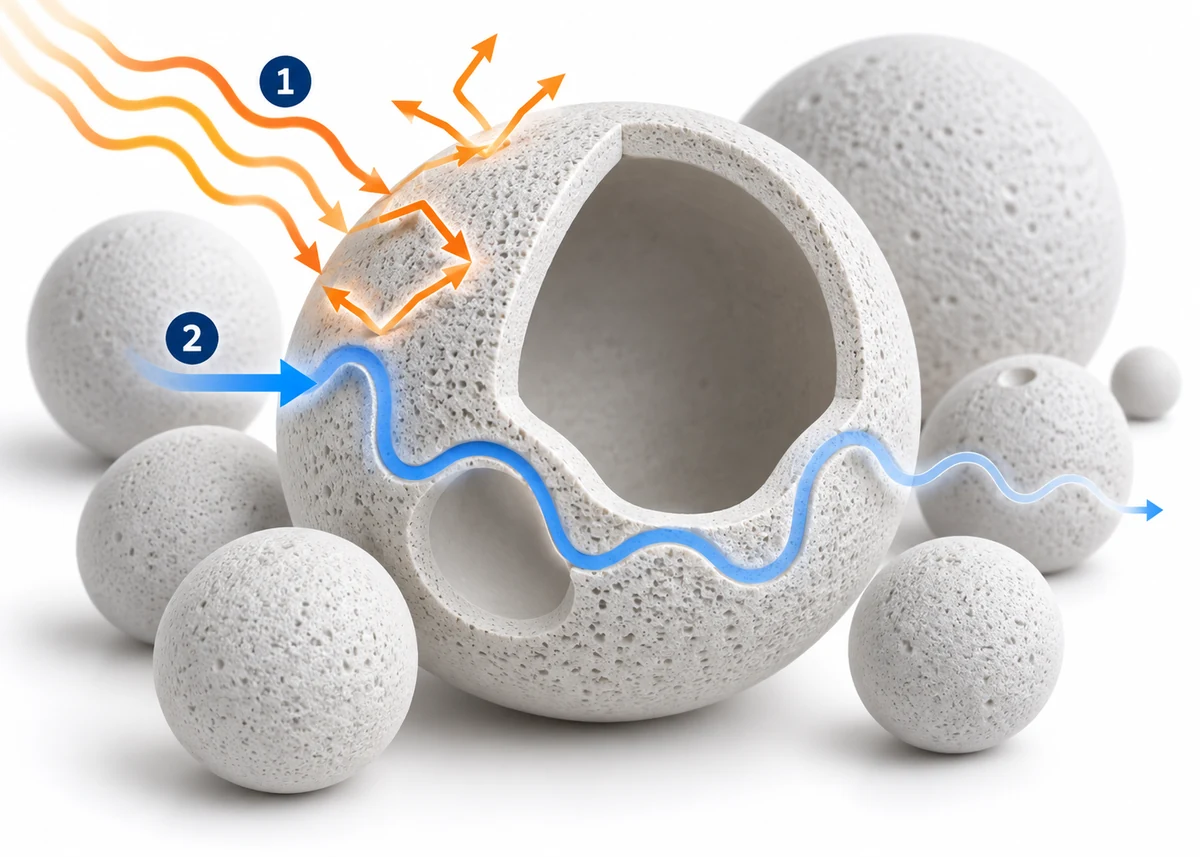
A hollow ceramic nanosphere shown in section among further spheres: heat radiation is reflected at the surface, while heat conduction takes a longer path around the cavities.

Simply explained

Heat moves across a facade along three paths. Nano facade insulation puts something in the way of each one — at three different places. There is therefore not one barrier, but three.

  1. 1

    The sun strikes the wall

    In summer, solar radiation falls on the facade. An ordinary surface absorbs a large part of it and warms up; that heat then travels on inwards. The top coat throws most of the radiation back before it is absorbed at all.

    Here the barrier is the surface itself. Solar energy that is reflected away does not need to be insulated against in the first place.

  2. 2

    The wall gives off heat

    Every surface warmer than its surroundings radiates heat — with no wind, and in the dark as well. How much it radiates depends not on temperature alone but on the nature of the surface. For the outer surface of nano facade insulation, an unusually low value is declared for this.

    The barrier is again the surface, only in the other direction: it radiates less than many common facade surfaces.

  3. 3

    Heat travels through the material

    In a solid material, particle lies against particle. Heat passes from one to the next along a short, continuous path — that is heat conduction. The coating is not solid: it is densely filled with hollow ceramic spheres, and between them the continuous solid is gone.

    Here the barrier is not a surface but a detour. The heat has to go around every cavity, countless times over. The path grows longer — and narrower.

Three paths, three places — and not one of them is a thick layer. That is precisely why the effect cannot be read off the thickness.

Confirmed by measurements

Each area stands on its own: with its characteristic value, its evidence — and with what it does not show.

01

Limiting heat conduction

The material structure of the functional layer and the top coat limits heat transport within the coating system.

Documented

Both coating layers contain ceramic hollow bodies and are functional parts of the system — the top coat is not merely a protective layer. The functional layer carries the larger share of the limitation of heat conduction; the top coat complements this effect and at the same time forms the reflective, UV- and weather-resistant outer surface.

Characteristic values

  • λ 0,000120 W/(m·K) Functional layer Source: Herstellererklärung – Wärmeleitfähigkeit (Lambda) je Schichttyp · Version 1.0, 10.07.2026 · Method: PN-EN 1745 View evidence →
  • λ 0,000416 W/(m·K) Top coat Source: Herstellererklärung – Wärmeleitfähigkeit (Lambda) je Schichttyp · Version 1.0, 10.07.2026 · Method: PN-EN 1745 View evidence →

What this shows

  • Both layers are thermally effective.
  • The functional layer has the stronger heat-conduction-limiting effect.
  • The manufacturer declares a separate system lambda value for each layer type.

What it does not show

  • That every wall build-up reaches the same U-value.
  • That the lambda values are classic material values of a homogeneous insulating material — the manufacturer declares them as layer-type-specific system values.
  • That the coating replaces a particular thickness of an insulation system.
02

Surface and thermal radiation

The coating changes the radiative properties of the outer surface and thus influences part of the heat exchange with the surroundings.

Partly documented

At every outer surface, a facade exchanges heat with its surroundings — through air movement and through thermal radiation. Air movement is largely determined by wind and weather; the radiative properties, by contrast, depend directly on the surface. A low emissivity is declared for nano facade insulation. Its behaviour towards long-wave thermal radiation therefore differs from that of many common facade surfaces.

Open, and expressly not claimed: an independent, appreciable influence of the coating on air movement at the surface has not been quantitatively demonstrated so far. What is documented is the radiative component, not the total surface heat transfer.

Characteristic values

  • ε 0,08 Outer surface Source: Technische Information für Energieberater This evidence is not yet publicly available.

What this shows

  • The surface has a documented, unusually low emissivity.
  • This changes the radiative exchange between facade and surroundings.

What it does not show

  • That the coating influences air movement at the facade.
  • That total heat transfer at the surface falls by any particular amount.
  • That emissivity were the same as solar reflectance — these are two different parts of the spectrum.
03

Reflecting solar energy

The outer surface reflects a high proportion of incoming solar radiation. The facade therefore absorbs less solar energy.

Documented

When solar radiation strikes a facade, part of it is reflected and part is absorbed by the surface. The absorbed share warms the facade and can then be passed on into the building element as heat. The top coat throws a high proportion back at the surface itself — solar energy that never reaches the wall does not need to be insulated against. This refers exclusively to solar energy arriving from outside.

Characteristic values

  • TSR 92 % Top coat Source: CE-Kennzeichnung PSC 250 T · Version 04/2026 · Method: Hotbox, TÜV-bestätigt View evidence →

What this shows

  • A high proportion of incoming solar radiation is reflected.
  • This limits the solar warming of the facade surface.
  • It matters above all for summer thermal comfort.

What it does not show

  • That 92 % of a building’s heat is retained — the value describes the reflection of solar radiation.
  • That any particular cooling or heating demand follows from it.
  • That the value applies to every colour shade — that remains to be documented.
  • That the reflection reduces heat loss from inside to outside in winter.
04

Overall effect on the building element

A very low rate of heat flow was determined on a real historic solid wall over almost twelve hours.

Measured on the element

The three areas explain why the coating can act thermally. What matters, however, is what arrives at the finished wall — and that cannot be calculated by adding up the individual properties. During a continuous measurement on an inhabited historic solid wall with roughly 0.5 mm of coating, 42.978 data records were logged over 11 h 57 min. In the stable evaluation window from 01:15–03:15, the U-value determined averaged 0.140 W/(m²K); across the entire later measuring phase it was 0.195 W/(m²K).

Characteristic values

  • U 0,140 W/(m²K) historic solid wall, evaluation window 01:15–03:15 Source: In-situ-Messung PSC-U-2026-001, Testo 635-2 · Version 06./07.09.2026 · Method: In-situ-Ermittlung mit Testo 635-2 und U-Wert-Kit View evidence →

What this shows

  • A very low rate of heat flow was determined on the element examined, under documented conditions.
  • The value does not come from a single reading but from a complete measurement series.
  • A measurement error identified at the start was documented and excluded from the evaluation.

What it does not show

  • That every wall treated with nano facade insulation reaches this U-value — the value applies to this element under these conditions.
  • That the measurement replaces accredited laboratory testing or a building-control assessment.
  • That a building’s energy consumption follows from it — use, building services and climate come into that.

Transparency is part of the evidence.

Well documented

  • Thermal function of both coating layers
  • System lambda values by layer type
  • Emissivity of the outer surface
  • Total solar reflectance
  • In-situ determination of the U-value on a real building element

Still being investigated

  • What share the surface effect contributes to the overall result
  • Whether the coating influences air movement at the facade
  • Transferability to other wall build-ups
  • Direct long-term measurement of heat flow
  • Comparison of a treated and an untreated area under identical conditions

NANO.WIKI grows with every new measurement.

In preparation

Next piece of evidence: long-term measurement of heat flow

In the winter of 2026/27 the chain of evidence is to be extended by a direct long-term measurement. Continuous measurements of treated wall areas are planned and — where the particular building allows — parallel reference measurements of untreated areas. Raw data, measurement conditions and evaluation will then be published.

We make no promise in advance about the result. What is measured is what is measured.

The original documents

This page explains. The documents behind it — declarations of performance, manufacturer declarations, technical data sheets, measurement reports and raw data — are held in full in NANO.DOCS.

Open NANO.DOCS Measurement report as PDF